
Table of Contents
Chicago summers are humid and winters bring snow and ice that melts into foundations. And a huge chunk of the city’s housing stock is old. We’re talking pre-1960s construction in neighborhoods like Hyde Park, Lincoln Park, and Wicker Park. Put all that together, and you’ve got near-perfect conditions for mold to grow quietly behind walls, under floors, and in basements where nobody’s looking.
Black mold in Chicago homes is more common than most people realize and it rarely announces itself until it’s already become a real problem.
In the event that you’ve experienced a smell of musty or dark spots on the walls, or have family members experiencing symptoms of an allergy that are not explained, this guide is a must-read prior to doing anything else.
What Is Black Mold, Exactly?
“Black mold” is commonly known as Stachybotrys chartarum. It is a dark greenish-black fungus that invades surfaces containing a lot of cellulose. This includes the ceiling, drywall, tiles, and insulation. It can be found in the basement and bathrooms in areas that have evident water damage. It needs moisture and that is a place it is commonly found.
There are many dark spots that could be Stachybotrys chartarum and any other mold that grows inside is something to be addressed. Color alone isn’t enough to reveal the whole story. A professional Mold Inspection Chicago IL service is the most reliable way to identify the type of mold present, locate hidden growth and determine the extent of the problem.
Why Chicago Homes Are Especially Vulnerable
Chicago has specific conditions that make the problem worse here than in many other cities.
Here’s what contributes to mold in Chicago homes:
- Old housing stock – Chicago old homes mold problems are common because aging foundations crack, pipes leak slowly, and original insulation breaks down over time
- Basement flooding – mold after flooding in Chicago spikes every spring when snow melts and heavy rain hits older drainage systems
- High summer humidity – indoor mold in Chicago humidity levels regularly exceed the 60% threshold where mold starts to thrive
- Poor ventilation – older homes weren’t built with modern airflow standards, trapping moisture inside walls
- Lake effect weather – temperature swings cause condensation inside walls, especially in poorly insulated homes
Neighborhoods with older brick two-flats and greystones, Hyde Park, Lincoln Park, Wicker Park tend to see this more often than newer construction areas.
Chicago Black Mold Warning Signs to Watch For
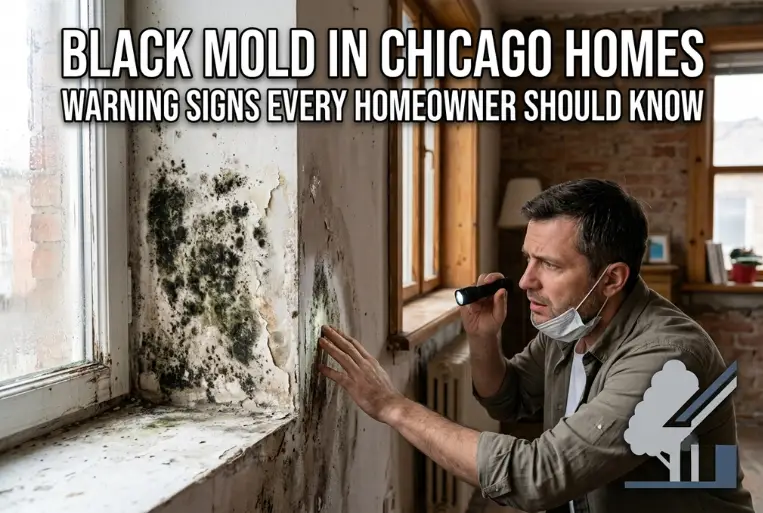
Most people don’t find mold by looking for it. They find it because something else tips them off. Here are the most common Chicago black mold warning signs:
Warning Sign | What It Could Mean |
Musty or earthy smell in a room | Mold growing inside walls or under floors |
Dark spots on drywall or ceilings | Active mold growth, possibly spreading |
Peeling or bubbling paint | Moisture trapped behind the surface |
Warped or soft flooring | Water damage mold likely underneath |
Condensation on windows regularly | High indoor humidity, mold risk elevated |
Recent water leak or flood | High probability of mold within 24–72 hours |
Allergy symptoms worse indoors | Possible airborne mold spores |
Basement mold in Chicago is especially easy to miss because people don’t spend much time down there. Check yours regularly, especially after heavy rain or a plumbing issue.
Black Mold Health Risks Chicago Residents Should Know
Black mold health risks for Chicago residents range from mild irritation to more significant respiratory problems, depending on the exposure level and the person’s health.
Common toxic mold symptoms Chicago residents report:
- Persistent coughing or sneezing
- Itchy, watery eyes
- Skin irritation or rashes
- Chronic headaches
- Fatigue that doesn’t go away
- Worsening asthma or allergy symptoms
- In severe cases, shortness of breath and respiratory infections
Children, seniors or anyone who suffers from an impaired immune system or being diagnosed with respiratory disease are at greater risk. If symptoms appear on multiple people within the same household, then mold exposure should be ruled out.
When to Call a Mold Contractor in Chicago
Severe mold damage often requires more than remediation alone. Experienced Home Remodeling Contractors Chicago IL and Surrounding Suburbs can repair moisture-damaged areas and restore the safety, appearance, and value of your home. There’s a lot of DIY mold content online. Some of it is fine for very small, surface-level issues. But here’s an honest breakdown of when to handle it yourself versus when to call a professional:
Handle it yourself only if:
- The mold patch is smaller than 10 square feet
- It’s on a non-porous surface (like tile or glass)
- You know exactly what caused it and the moisture source is fixed
- You have no health conditions that make exposure risky
Call a mold contractor in Chicago when:
- The area is larger than 10 square feet
- You can smell mold but can’t find it (it’s inside walls)
- Mold came back after you cleaned it
- There was recent flooding or a slow leak you didn’t catch early
- Anyone in the home has health symptoms
- You’re buying or selling a property
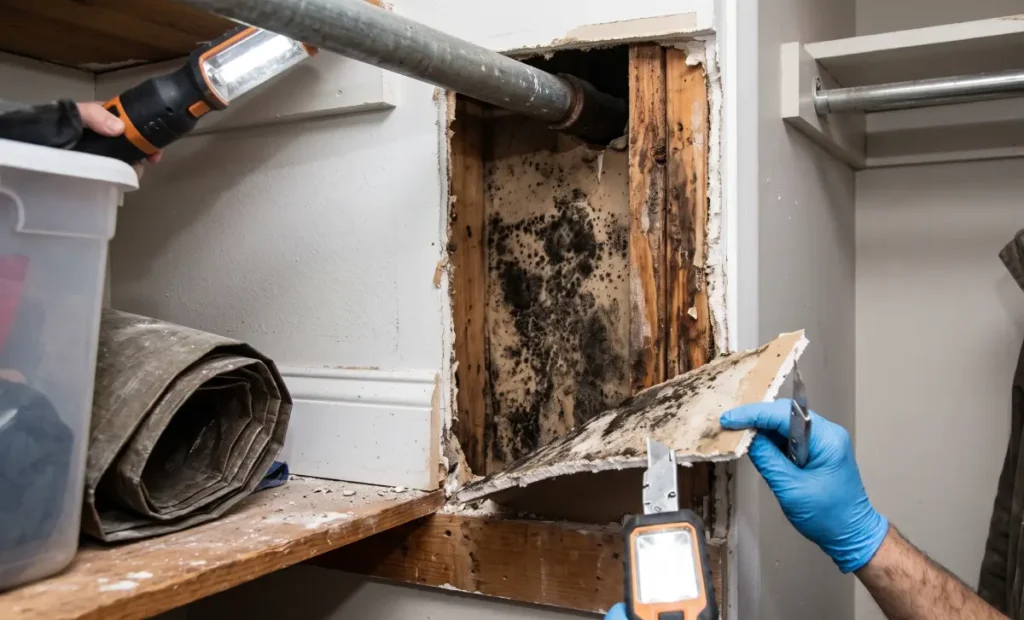
Mold inside walls, in HVAC systems, or under flooring is not a DIY job. It requires containment, proper removal, and treating the source otherwise it grows back.
The Mold Remediation Process: What Actually Happens
If you’ve never gone through mold remediation in Chicago, IL, here’s what a professional process looks like step by step:
- Inspection — A contractor assesses the visible damage and checks for hidden mold
- Mold testing — Samples are taken to identify the mold type and spore levels
- Containment — The affected area is sealed off to prevent spores from spreading
- Removal — Contaminated materials are removed safely
- Cleaning & treatment — Surfaces are treated with antifungal agents
- Drying & repairs — The area is dried out and rebuilt (drywall, flooring, etc.)
- Post-clearance testing — A final test confirms the mold is gone
A proper job addresses the moisture source, not just the visible mold. If the root cause isn’t fixed, mold comes back, guaranteed.
Is Black Mold Hiding in Your Home?
Don’t wait for mold to spread. Get a professional inspection and protect your home in Chicago before the damage gets worse.
How Much Does Mold Remediation Cost in Chicago, IL?
Mold inspection cost in Chicago and remediation pricing varies quite a bit depending on the size of the problem. Here’s a general range:
Service | Estimated Cost Range |
Basic mold inspection | $200 – $600 |
Mold testing (lab analysis) | $100 – $300 additional |
Small area remediation (under 10 sq ft) | $500 – $1,500 |
Mid-size remediation (10–100 sq ft) | $1,500 – $5,000 |
Large or whole-home remediation | $5,000 – $15,000+ |
Basement mold remediation | $2,000 – $8,000 depending on severity |
Mold remediation cost in Chicago, IL goes up when structural materials like drywall or flooring need to be replaced which is common in older homes or after flooding. Getting an inspection first gives you a clear picture before committing to anything.
FAQs
Work With a Team That Treats Your Home Like It’s Their Own
If you’ve seen mold or you feel that there’s something wrong, don’t put off getting it fixed. Natures Builders LLC is a full-service construction and mold remediation firm founded on honesty that is sustainable, safe practices, and a real sense of accountability at every step. From inspections to complete repair and remediation everything is completed on-site by experienced professionals who are familiar with Chicago homes from top to bottom.
Black mold removal in Chicago is something Natures Builders LLC handles with care not just cleaning the surface, but finding the source and making sure it doesn’t come back.
📍 Natures Builders LLC, Chicago, IL 📞 Reach out today via Email:Info@naturesbuilders.com, Phone: (708) 719-2740 to schedule an inspection or get a quote. No pressure, just straight answers.