
Chicago summers hit hard and Chicago winters hit harder. If you own a home here, you already know what that does to your energy bills. The heating runs for months. The cooling kicks in fast. And somewhere in the middle, your house is working overtime just to stay comfortable.
The good news is the limited and specific upgrades you make can result in lower utility costs, better comfort, and longevity of the home. The unfortunate news is the majority of home owners get stuck at the same question. What step does one take first?
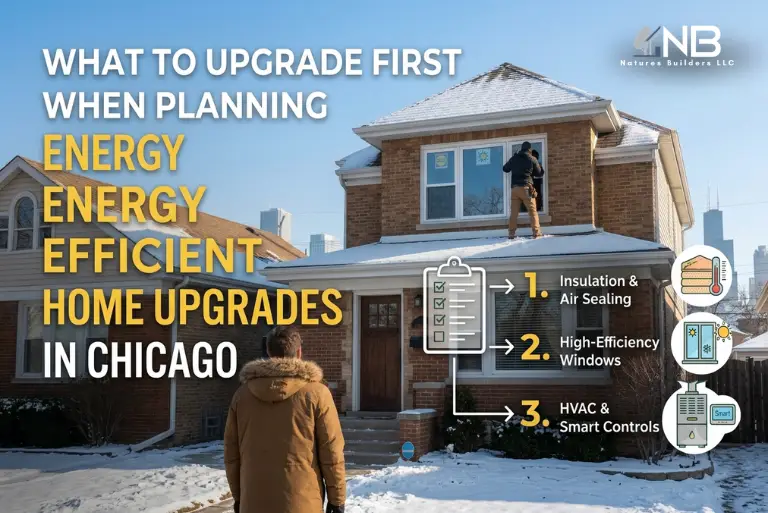
This guide breaks it down simply. Here’s what to prioritize first when planning energy efficient home upgrades in Chicago in the order that actually makes sense.
Start with a Home Energy Audit Before Energy Efficient Home Upgrades in Chicago
Do an audit before spending money.
A home energy audit is a diagnostic assessment like something you would do for your health. An evaluator will assess your insulation, seals on doors and windows, air leaks, and your HVAC. You will get prioritized suggestions on ways to cut energy cost. It takes about 2 hours and can save you from spending money in the wrong place.
What an audit tells you:
- Where your home is losing heat or cool air
- How efficient (or inefficient) your current HVAC is
- Whether your insulation is doing its job
- Air sealing opportunities you probably didn’t know existed
This one step changes everything. It turns guesswork into a clear action plan.
#1: Air Sealing and Insulation Should Be Your First Energy Efficient Home Upgrade
This is almost always the first real upgrade to make and it’s often the most overlooked.
Chicago homes, especially older ones in neighborhoods like Logan Square, Bridgeport, or Pilsen, lose a huge amount of energy through gaps, cracks, and thin insulation. Before upgrading your HVAC or windows, sealing those leaks is critical. Otherwise, you’re just conditioning air that’s escaping.
Common spots where Chicago homes leak air:
- Around window frames and door edges
- Attic hatches and recessed lights
- Basement rim joists
- Plumbing and electrical penetrations in walls
Good attic insulation alone can cut heating costs by 10–50% depending on your home’s current condition.
Upgrade | Avg Cost (Chicago) | Potential Energy Savings |
Air sealing | $200–$1,000 | Up to 20% |
Attic insulation | $1,500–$3,500 | 10–50% |
Wall insulation | $2,000–$6,000 | 10–20% |
#2: Upgrade Windows and Doors for Better Energy Efficiency
Once your house is adequately weather sealed and insulated, the next big factor is the windows, particularly in the older Chicago homes that have single-pane windows.
Windows that have two or three panes and have low-E coatings can make a significant decrease in the transfer of heat. These windows hold the heated air in during the frigid winters and block the solar heated air from entering during the summer. That’s a win any time of year in this climate.
What to look for in replacement windows:
- Double or triple-pane glass
- Low-E (low emissivity) coating
- ENERGY STAR certification
- Proper professional installation, gaps defeat the whole purpose
Door upgrades matter too, especially your front door and any doors leading to an unheated garage or basement. Many homeowners planning larger renovations also coordinate these upgrades with Interior Design Services Chicago to improve both efficiency and the overall appearance of their living spaces.

Start Your Energy-Efficient Home Upgrade
Get expert recommendations tailored to your home’s needs and your budget.
#3: HVAC System: Heat Pumps Are Worth Talking About
If your furnace or AC is over 15 years old, replacing it will likely pay for itself faster than you’d expect. Professional HVAC Services Chicago homeowners rely on can help determine whether repairing or replacing your current system is the most cost-effective option.
One option gaining popularity in Illinois is the heat pump. A heat pump handles both heating and cooling in one system. Older versions struggled in very cold temps, but modern cold-climate heat pumps work well even when it drops below zero which matters a lot for a Chicago winter.
Heat pump pros for Chicago homes:
- One system replaces both furnace and AC
- Can cut heating costs significantly compared to gas
- Qualifying heat pumps may be eligible for federal tax credits under current federal law. Homeowners should verify current IRS requirements and eligibility before purchasing.
- Qualifies for Illinois rebates through ComEd and Nicor Gas programs
If a full heat pump isn’t in the budget right now, upgrading to a high-efficiency furnace (90%+ AFUE rating) is still a meaningful improvement.
#4: Choose an Energy-Efficient Water Heater to Lower Utility Bills
In most residences, the largest cost of energy is for heating and cooling, and the second is water heating. Compared to a standard electric tank water heater, a heat pump water heater is 2-3 times more energy efficient. Qualifying heat pump water heaters may be eligible for federal tax credits under current IRS guidelines, subject to annual limits and eligibility requirements.
If you’re doing a broader sustainable home renovation in Chicago IL, replacing your water heater at the same time as other upgrades often makes the most financial sense.
#5: Smart Thermostat + LED Lighting
These are lower-cost upgrades but worth doing alongside bigger projects.
Smart thermostats:
- Learn your schedule and adjust automatically
- Can cut heating and cooling costs by 10–15%
- ComEd offers rebates on qualifying models
- Most homeowners see payback in under 2 years
LED lighting:
- Uses up to 75% less energy than incandescent bulbs
- Lasts 15–25 times longer
- Costs very little upfront, easiest win on this list
Should Solar Panels Be Part of Your Energy Upgrade Plan?
Solar panels are certainly a valuable energy source, but typically should not be the first upgrade for your house. A more synergistic energy use should be achieved first by improving insulation and/or optimizing the systems for heating, cooling, and ventilation, and then sizing your solar system. More efficient homes need less energy, thus a smaller array.
Illinois has solid solar incentives including the Illinois Shines program (Solar Renewable Energy Credits).
Chicago-Specific Rebates and Incentives (2026)
One of the best parts of doing eco-friendly home remodeling in Chicago right now is the available financial support.
Program | What It Covers | Who Offers It |
ComEd Energy Efficiency | Insulation, smart thermostats, HVAC | ComEd |
Nicor Gas Rebates | Furnace, water heater, insulation | Nicor Gas |
Federal Tax Credits (IRA) | Heat pumps, windows, water heaters, solar | Federal Government |
Illinois Shines | Solar panels | IL Power Agency |
City of Chicago PACE | Financing for energy upgrades | City of Chicago |
The federal Inflation Reduction Act credits run through 2032 and cover up to 30% of costs for many upgrades, including heat pumps, windows, insulation, and more. That’s a big deal. Many homeowners planning Solar Panel Installation Chicago also take advantage of available state incentives to reduce upfront costs.
The Best Order for Energy Efficient Home Upgrades in Chicago
Here’s a simple sequence if you’re planning a phased approach:
- Get an energy audit first
- Seal air leaks and upgrade insulation
- Replace windows and exterior doors
- Upgrade your HVAC system
- Replace your water heater
- Add smart thermostat and LED lighting
- Consider solar once efficiency is dialed in
Following this order means each upgrade builds on the last. You won’t oversize your HVAC because your insulation is now doing its job. You won’t spend more on solar than you need to.
Know more about How to Plan for Home Remodeling Cost in Chicago IL Without Blowing Your 2026 Budget.
Why Hire a Green Building Contractor in Chicago for Energy Upgrades
Not every contractor understands the specific demands of Chicago’s climate, the freeze-thaw cycles, the older housing stock, the combination of brutal cold and humid summers.
A green building contractor in Chicago who specializes in energy efficiency knows which insulation products hold up long-term here, how to properly install cold-climate heat pumps, and how to tie everything together so upgrades work as a system, not just as individual fixes.
That’s the difference between a home that feels improved and one that actually performs better year after year.
FAQs
What are the most effective energy efficient home upgrades for Chicago homes?
Are there rebates or incentives for energy efficient home upgrades in Chicago?
What is a home energy audit and do I need one before upgrading my Chicago home?
How much can Chicago homeowners save with energy efficient upgrades?
Is a heat pump a good choice for heating and cooling a Chicago home?
Modern cold-climate heat pumps work well in temperatures far below 0°. Because of this, they are a great option in Chicago. They perform heating and cooling in one unit and are eligible for generous federal tax credits. Discuss with your contractor about whether your home would be a good candidate.
What free energy efficiency programs are available in Chicago?
The City of Chicago connects residents to weatherization assistance programs for income-eligible households. Check the Illinois Home Weatherization Assistance Program (IHWAP) if you qualify. Natures Builders provide energy-efficient systems and smart solutions that reduce consumption while supporting reliable buildings.
Ready to Make Your Chicago Home More Energy Efficient?
We offer considerate and transparent home upgrade services in Chicago at Natures Builders LLC. Most contractors do not show concern for the clients. Your home deserves more. Our team handles every project personally. We do everything from the installation of sustainable house features to the renovation of entire home systems and replacements of windows and insulation.
We would love to help you enhance both the comfort and health of your home while also reducing energy costs. We plan every project. We can help you determine where to begin enhancing your home.
📞 Call or reach out to Natures Builders LLC at (708) 719-2740 or email us at Info@naturesbuilders.com today to schedule a consultation and take the first step toward a smarter, more efficient home.